

How Clean Does A Gasket Surface Need To Be
Improper Engine Gasket Cleaning Methods Using Surface Workout Discs
When cleaning engine gasket sealing surfaces or cleaning parts from an engine that are to be reused, it's critical to not use surface workout discs, such equally abrasive pads or beard. These discs tin can cause damage to the sealing surface or generate debris that will cause damage to bearing surfaces in bandage iron and aluminum engine blocks.
TIP: Dealerships that utilize improper gasket cleaning methods that event in engine failure will be debited the cost of the replacement and repair.
Abrasives Cause Engine Damage
Annoying pad or bristle devices (Fig. viii) — typically made of woven fiber or molded bristles — should not exist used because:
- Abrasive pads volition produce fine grit that the oil filter will not be able to remove from the oil. This dust is annoying and may cause internal engine impairment. Abrasive pads can hands remove enough fabric to round cylinder head surfaces, which can bear on the gasket'south ability to seal, peculiarly in the narrow seal areas between the combustion chambers and coolant jackets.
- Annoying pads, wire, and safety finger wheels can remove enough metal to touch cylinder head, block, oil pan runway, and intake manifold runner flatness, which can cause coolant and oil leaks and air leaks. Information technology takes about 15 seconds to remove 0.203mm (0.008 in.) of metal with an abrasive pad.
- Abrasive pads, rubber finger wheels and wire wheels with high-speed grinders produce air-borne debris that tin travel throughout the store and contaminate other work being performed outside of the immediate piece of work surface area.
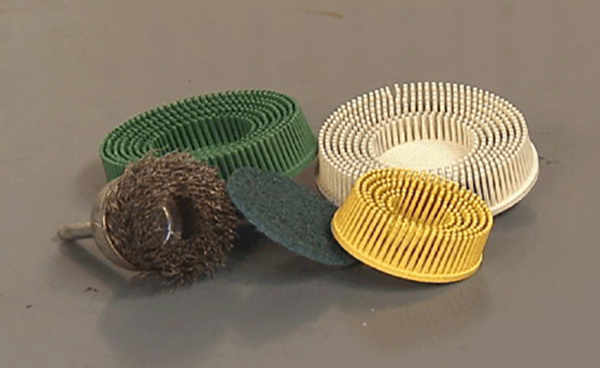
Fig. 8
When using surface conditioning discs that contain abrasives, aluminum oxide (a common component of sandpaper) is dislodged from the disc along with metallic particles from the engine component. Even the finger-type discs, which don't appear to have any blazon of abrasive fabric, contain aluminum oxide. The presence of aluminum oxide in engine oil has been shown to cause premature engine bearing failure, in some cases, in as little as 1,367 miles (two,200 km) or less subsequently the repair has been made.
Surface workout discs also may grind the component material and imbed it into the disc when more aggressive grinding of the gasket surface takes identify.
Whatever debris from these surface conditioning discs cannot be properly cleaned from the oil passages with store air or solvents.
Recommended Cleaning Procedures
GM recommends the employ of a razor blade or plastic gasket scraper to clean the gasket surface on engine components that are to be reused. When using a razor bract-type gasket scraper, apply a new razor blade for each cylinder head and corresponding block surface. Hold the bract every bit parallel as possible to the gasket surface to ensure that the razor blade does not gouge or scratch the gasket surfaces. Do not gouge or scrape the combustion bedchamber surfaces or any engine-sealing surface during the cleaning process.
To properly make clean the sealing surface prior to reassembly, GM Low VOC Cleaner, part number 19287401 (in Canada, office number 88901247), should be sprayed on the mating surface. Avoid getting solvent in any expanse other than the mating surface to be cleaned. Allow information technology to soak in for several minutes to loosen old RTV sealer/gasket material.
TIP: GM recommends using a plastic razor bract or non-metallic scraper to remove all loose sealer/gasket material.
When cleaning engine components, the feel of the sealing surface is disquisitional, not the appearance. After all the gasket cloth is removed, there will be indentations from the gasket left in the cylinder head. The new gasket will fill these small indentations when it is installed.
For boosted information, refer to GM Bulletin #00-06-01-012F.
– Thanks to Tracy Lucas

How Clean Does A Gasket Surface Need To Be,
Source: https://gm-techlink.com/?p=7689
Posted by: carmichaelshad1981.blogspot.com
0 Response to "How Clean Does A Gasket Surface Need To Be"
Post a Comment